AZIS R. DABAS / WHOLE-CARE SYSTEMS
One person.
A connected system.
Clinical care, pharmacy, behavioral health, social support and intelligence become valuable when they work together around a person’s goals. The strategic challenge is to connect the decisions, capacity and economics between them.
An original operating framework and research synthesis. Explore 16 domains, test a capacity-constrained service model, and examine the evidence behind emerging approaches.

Closure requires more than a referral: a named owner, a delivered service and verified follow-through.
01 / THE INTERCONNECTED LAYER
Connect the decisions.
Own the unfinished work.
Select a domain to inspect its care pathway, economics, decision rights and evidence. These are parts of one proposed operating architecture; they are not claims that a single platform or intervention has proved every outcome.
01 / The person
Start with the person’s goal.
What does this person want help with—and what are they willing to share?
- Care pathway
- Establish a stated goal, preferred contact method, language and accessibility needs. Record the person’s decision to accept, defer or decline support. A caregiver can participate when authorized; their workload belongs in the plan.
- Economic dependency
- Identify who pays for assessment, navigation and the actual service. A person should not need to understand the organization chart to find out what help is available.
- Decision rights
- A named navigator maintains the shared plan. Clinical decisions remain with the appropriate licensed team; the person retains a practical way to correct information and change participation.
- Evidence to inspect
- Track reach among the entire eligible population, experience of the offer, accepted support and goals achieved. Keep a decline distinct from an inaccessible or unavailable service.
02 / Pharmacy
A prescription is the beginning of a pathway.
Can the person obtain, understand and safely use the intended therapy?
- Care pathway
- Connect the reconciled regimen, clinical appropriateness, benefit pathway, affordability, dispensing and follow-up. Route discrepancies and possible adverse effects to a pharmacist and prescriber. A paid claim does not establish that a medicine was taken.
- Economic dependency
- Separate drug acquisition, dispensing, clinical-service cost, patient expense and medical spending. A higher pharmacy cost can be compatible with better care; any claimed medical-cost offset needs its own evidence.
- Decision rights
- The pharmacist owns medication review within scope; the prescriber owns prescribing decisions. A coordinator owns access exceptions and confirms that the next team received the action.
- Evidence to inspect
- Measure time to an appropriate start, unresolved access barriers, clinically reviewed discrepancies and follow-up completion. Pair adherence proxies with patient context and clinical measures.
03 / Behavioral health
Build a team around the treatment plan.
Who notices that the person is not improving—and who can change the plan?
- Care pathway
- Connect primary care, a behavioral care manager and psychiatric consultation around a registry and agreed review cadence. Offer appropriate alternatives when preferences, severity or access make the initial route unsuitable.
- Economic dependency
- Fund the care manager, specialist review, outreach and clinical supervision. Appointment volume and billable encounters alone do not describe the cost of keeping a population in treatment.
- Decision rights
- The treating team defines escalation, review intervals and clinical pathways. AI can assist with documentation or routing; it does not independently diagnose, change medication or manage a crisis.
- Evidence to inspect
- Inspect engagement, symptoms, functioning, treatment adjustment and access by subgroup. More screens without timely treatment capacity can enlarge an unresolved queue.
05 / Signals & sensing
A signal earns a question, not a conclusion.
What has this device actually measured, and would responding improve care?
- Care pathway
- Distinguish radio-derived movement or respiration from an interpretation of sleep or mobility. A change can prompt a consented check-in; its cause may be clinical, environmental, behavioral or technical.
- Economic dependency
- Include installation, calibration, connectivity, replacements, review time and false alerts. Value depends on an effective response to useful signals, not the volume of measurements collected.
- Decision rights
- Define who is monitored, who can see the data, how co-residents are protected and how sensing can be paused. Validate the exact hardware and intended setting before giving the output a clinical role.
- Evidence to inspect
- Require signal quality, external validation, prospective workflow performance and incremental benefit. Wireless signals do not directly establish food insecurity, housing instability or a psychiatric diagnosis.
06 / Payer & provider
Make the contract support the care.
Who carries the cost now, who benefits later, and who is accountable when delivery fails?
- Care pathway
- Align the care plan across hospital, primary care, specialists, pharmacy and community services. Authorization, discharge information and appointment capacity are separate dependencies that need explicit owners.
- Economic dependency
- Reconcile participant contribution, purchaser spending and patient expense. State the payment basis, attribution period, quality conditions, exclusions, reconciliation delay and working capital needed before payment.
- Decision rights
- The agreement assigns service obligations, information rights, dispute resolution and responsibility for exceptions. Coverage review and clinical judgment remain distinct decisions.
- Evidence to inspect
- Show both contractual settlement and a credible comparison for incremental benefit. An incentive payment is a transfer; it is not itself proof of lower resource use or improved health.
07 / AI & coordination
Make uncertainty visible to the next owner.
Can every proposed action be traced to its source, authority and completion state?
- Care pathway
- Use a shared work queue with provenance, timestamps and explicit states: requested, accepted, scheduled, delivered, declined, unavailable or unresolved. A conversational interface can help people navigate this system; it cannot substitute for delivery capacity.
- Economic dependency
- Value the total workflow: integration, review, exceptions, support and retained benefit. Distinguish time released from cash removed and from capacity that can actually be used.
- Decision rights
- Separate observations, recommendations and authorized actions. Preserve source evidence, permission scope, escalation rules and a recovery path when data are stale, conflicting or missing.
- Evidence to inspect
- Measure task accuracy alongside completion, workload, missed exceptions and downstream effects. A model’s confidence is not a calibrated guarantee, and automation should stop at the agreed boundary.
08 / Primary care
Make continuity a funded capability.
Which team remains responsible between visits?
- Care pathway
- Connect panel attribution, access, prevention, multimorbidity and specialty follow-through. Separate an encounter from continuity with a named team and a current plan.
- Economic dependency
- Model panel complexity, contact work, clinician time and team capacity. A prospective payment must support the promised service intensity, with clear adjustment when need changes.
- Decision rights
- The primary-care team maintains the longitudinal plan; specialists and navigators accept specific tasks. Conflicting recommendations return to a named clinical owner.
- Evidence to inspect
- Inspect continuity, time to appropriate care, unresolved referrals and outcomes across the entire panel. More contact is a process measure, not proof of benefit.
09 / Hospital & acute care
Treat capacity as a clinical constraint.
Which safe transition releases the next staffed bed?
- Care pathway
- Map emergency arrival, diagnostic decisions, admission, treatment, discharge readiness and the receiving setting. An available physical bed is not necessarily staffed capacity.
- Economic dependency
- Separate occupancy, acuity, length of stay, net payment and variable cost. A released bed-day creates value only when demand, staff and downstream access permit its use.
- Decision rights
- Clinical teams own admission and discharge decisions. Operations owns the coordination needed to execute them safely; financial targets cannot substitute for clinical readiness.
- Evidence to inspect
- Pair throughput with revisits, readmissions, patient experience and subgroup access. Test whether demand is genuinely met or merely moved elsewhere.
10 / Kidney & chronic care
Coordinate a pathway across settings.
Who owns the next transition in a long treatment journey?
- Care pathway
- Connect primary care, nephrology, treatment education, patient preferences, vascular access, treatment initiation and hospital transitions. Coordinate transport and medication access around the chosen plan.
- Economic dependency
- Map treatment capacity and referrals alongside the payer mix, collection timing and fully loaded service cost. Keep network growth separate from claims about clinical improvement.
- Decision rights
- Licensed teams and the person determine treatment. Intake owns the acceptance handoff and resolves missing records, benefit checks and available appointments.
- Evidence to inspect
- Track time to a clinically appropriate start, reasons for unresolved intake, continuity and acute utilization. Distinguish self-reported commercial results from comparative clinical evidence.
11 / Oncology & specialty care
Manage time, toxicity and access together.
Can the complete treatment pathway actually be delivered?
- Care pathway
- Connect diagnostic resolution, specialist assessment, shared treatment decisions, testing, therapy access and symptom escalation. A coordinated pathway includes caregiver support and financial barriers.
- Economic dependency
- Disaggregate diagnostic, drug, infusion, professional and facility economics. Model authorization delays, acquisition exposure and the cash required before reimbursement.
- Decision rights
- The clinical team owns regimen selection and toxicity management. Coordinators own the records, scheduling and access exceptions needed to carry out the plan.
- Evidence to inspect
- Evaluate time to appropriate treatment, abandoned pathways, patient burden and outcomes adjusted for relevant clinical differences. Do not use raw volume as a proxy for quality.
12 / Aging & home care
Make the home a supported care setting.
What work does the plan assume the caregiver can do?
- Care pathway
- Connect function, cognition, medication, home conditions, caregiver availability and the person’s goals. Plan for deterioration and out-of-hours support, not only scheduled visits.
- Economic dependency
- Include travel, missed visits, supervision, supplies and caregiver burden. A lower facility bill can conceal costs shifted to families or an underfunded home workforce.
- Decision rights
- Agree on escalation and backup arrangements with the person, caregiver and clinical team. Sensing can support an agreed response; it cannot replace available care.
- Evidence to inspect
- Assess days at home alongside function, safety, caregiver experience and unmet need. Interpret utilization changes in light of access and preferences.
13 / Women’s & maternal health
Design for continuity across life stages.
Where does a preventable loss of follow-up occur?
- Care pathway
- Map screening, diagnostic completion, reproductive and maternity care, postpartum support and longitudinal chronic care. Distinguish an invitation to screening from a resolved abnormal result.
- Economic dependency
- Align payment with the complete episode and necessary follow-up. Budget language access, navigation, behavioral care and coordination that fragmented billing may overlook.
- Decision rights
- The person and clinical team own preference-sensitive decisions. A named team owns abnormal-result follow-up and referral acceptance across organizational boundaries.
- Evidence to inspect
- Compare access, diagnostic resolution, respectful care and outcomes across groups. Explain denominator changes and missing follow-up before interpreting improvement.
14 / Children & family care
Include the family and the transition.
Can developmental and social support survive a change of setting?
- Care pathway
- Connect preventive care, development, behavioral support, specialty services and school or community resources with appropriate permissions. Plan adolescent transitions before they become a break in care.
- Economic dependency
- Value benefits over a suitable horizon; a child’s developmental or educational gain may not appear as near-term medical savings. Assign a sustainable payer for the enabling work.
- Decision rights
- Clarify guardian permissions, the child’s role and the receiving team’s responsibilities. Clinical judgments remain with appropriately qualified teams.
- Evidence to inspect
- Measure completed support, family experience, equitable reach and longitudinal function. Avoid treating a short claims window as a complete account of public value.
15 / Revenue & access operations
Make a valid service financially deliverable.
Which exception prevents an appropriate service from reaching payment?
- Care pathway
- Connect eligibility, authorization where required, scheduling, documentation, claim submission, adjudication and resolution. Preserve source evidence at every handoff.
- Economic dependency
- Distinguish recovered cash, accelerated cash, prevented loss and labor capacity. Do not count the same claim recovery again as cost savings or annual recurring revenue.
- Decision rights
- Assign clinical documentation, coding, appeal and financial authority explicitly. Automate within approved permissions; unresolved or disputed evidence returns to human review.
- Evidence to inspect
- Follow clean claims, aging, avoidable rework, appeal outcomes and patient burden. Use net recovery after fees and handling cost, with an auditable comparator.
16 / Capital & organizational design
Choose the boundary of the enterprise.
What must we own, and what can a contract accomplish?
- Care pathway
- Compare ownership, partnership and internal redesign against the same population and operating objective. Identify the specific decisions that a transaction would change.
- Economic dependency
- Reconcile return on capital, integration cost, concentration, cash timing and downside resilience. Higher revenue is not sufficient evidence of better economics or better care.
- Decision rights
- Give each material assumption an accountable executive, an evidence threshold and a reversible next commitment. Governance must be able to stop an attractive but failing thesis.
- Evidence to inspect
- Evaluate access, quality, cost and distributional effects as well as financial return. Observational ownership comparisons are hypotheses to investigate, not automatic acquisition justifications.
The connecting record is a commitment: a person’s goal, a requested action, a receiving owner, a permitted information flow, a funding path and a verified status. A referral sent is not a service delivered.
THE CONNECTED-CARE CONTRACT / PROPOSED ARCHITECTURE
A completed task needs evidence.
A failed handoff needs an owner.
A closure engine is a proposed operating design: a durable record of the commitment, the receiving owner and the evidence of what happened. These are workflow states, not an inference that care improved.
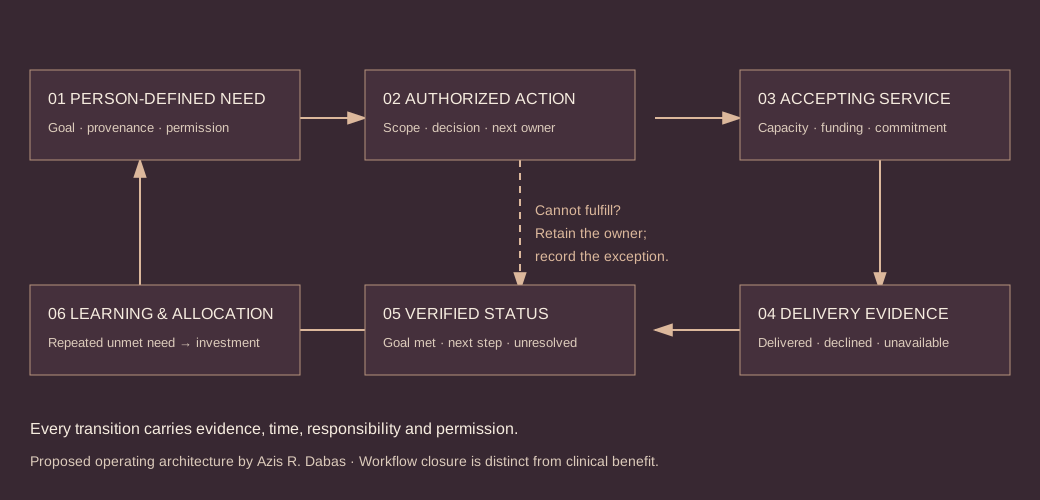
Establish the need
Person’s stated goal + source record + time + permission. A radio signal is an observation to assess, not a diagnosis or a confirmed social need.
Authorize the next step
Qualified review + person’s preference + scope of action. Accept, defer and decline are distinct decisions.
Secure a receiving owner
A named service accepts responsibility, confirms capacity and identifies the funding path. Sending a referral does not satisfy this gate.
Complete the service
Record delivery evidence, relevant time and who attested it. Missing authorization, unavailable capacity or no contact remain unresolved.
Reassess the goal
Confirm the next state with appropriate evidence. Service completion, need resolution and clinical benefit remain separate measures.
Reallocate resources
Repeated unresolved cases become a capacity, contract or design decision. Preserve the full eligible denominator and the reason for each exit.
Successful path: observe → agree → accepted → delivered → verified. Verification can reopen the plan when the person’s goal remains unmet.
Exception path: unavailable, disputed, expired or no response → retained accountable owner → alternate offer or explicit unresolved status → capacity review. Never manufacture a “closed” outcome to clear the queue.
03 / INTERACTIVE CARE ECONOMICS
Plan the whole path of care.
Reach, consent, service capacity and follow-up compete for the same investment. Change one assumption to see where a single-period program can deliver—and where the constraint moves.
Illustrative planning scenarios · One period · Expected counts may be fractional · USD · No patient data or clinical outcome prediction
Assumptions
Conditional rates use the prior stage as their denominator.
Adding service hours changes physical capacity only. Adjust fixed cost for additional reserved staff; per-completion service cost includes only incremental expense not already in fixed cost.
View updated results ↑Largest numeric drop
4,000 people not reached
The largest numeric drop is at reach. However, 1,150 expected completions exceed staffed capacity. Evaluate additional staffed hours and their full cost before expanding reach. A decision to decline is a choice, not a care failure.
Resources & contribution
Payment represents an optional service-delivery assumption, not clinical results or coverage.
| Staffed completion capacity | 2,000 people |
|---|---|
| Expected completions beyond staffed capacity | 1,150 people |
| Capacity utilization | 100% |
| Fixed + outreach + service + follow-up cost | $353,200 |
| Payment for completed services | $360,000 |
| Net contribution | $6,800 |
| Cost per completed service | $176.60 |
Compared with pinned baseline
0 change in completions · $0 change in net contribution.
Calculated locally in your browser. No data is submitted or stored.
View the model math and boundaries
Eligible population × reach rate = reached. Reached × consent rate = consented. Consented × expected completion rate = expected completions before capacity. Staffed completion capacity = staffed service hours ÷ hours per completion. Completed = the lesser of expected completions before capacity and staffed capacity. Completed × follow-up rate = followed up. Each rate is conditional on the immediately preceding stage.
Expected completions beyond staffed capacity = maximum of zero and expected completions before capacity less completions. Total cost = fixed program cost + outreach cost per reached person × reached + service cost per completion × completed + follow-up cost per person × followed up. Payment = payment per completed service × completed. Net contribution = payment less total cost. Cost per completed service = total cost ÷ completed when completed is positive. Capacity utilization = completed ÷ capacity when capacity is positive.
The completion rate estimates possible completion without the staffing cap; the pre-capacity difference is an expectation, not an observed service offer. The eligible total anchors the display bars. Declines are counted but are not care failures. This model does not estimate admissions avoided, health outcomes, clinical risk, payer eligibility, reimbursement terms, or CMS coverage. Variable service cost includes staff cost per completed service. Fixed cost includes reserved workforce and overhead; when adding staffed hours, adjust fixed cost for any additional staffing commitment. The quick hours action changes physical capacity only so the financial result needs a matching cost adjustment to be meaningful. Payment is an editable hypothetical service-delivery contract assumption; set it to zero when no payment is expected. The largest drop is a count across stages, not an assessment of clinical need.
04 / THE KNOWLEDGE BEHIND THE SYSTEM
Read deeply.
Make a better decision.
Original perspectives grounded in attributed scholarship and public program evidence. Each connects the research to a specific operating or allocation decision.
The therapy has to reach the person.
Appropriateness, access, safe use and follow-up as one accountable pathway.
↗BEHAVIORAL HEALTH & MULTIMORBIDITYIntegration is a clinical operating model.
Registry-based follow-up, team capacity and treatment adjustment beyond a referral.
↗SOCIAL NEEDS & PUBLIC HEALTHThe referral needs somewhere to go.
Service capacity, community economics and the difference between individual support and structural change.
↗WIRELESS SENSING & CLINICAL AIThe signal is not the social need.
What radio and Wi-Fi research can measure, what remains uncertain and how a response earns its place.
↗RECENT SCHOLARSHIPWhat research changes about the strategy.
Six selected 2025–2026 papers and their implications for executive decisions.
↗PAYER, HOSPITAL & CAPITALReconcile the economic argument.
Compare assumptions, inspect sensitivities and locate the threshold that changes the decision.
↗THE EXECUTIVE QUESTION
What would have to change
for the whole system to work?
My starting point is the institutional choice: which outcome to own, which dependency to fund, which partner to trust and what evidence earns the next commitment.
Bring the system-level question ↗FROM CARE DESIGN TO ECONOMIC VIABILITY