Medium source | Owned operator essay
The Orchestration Imperative
Editorial revision: . Original publication and source dates are retained.

Value-based care requires a reliable connection between patient need, available services and payment accountability. Orchestration is the work of carrying each decision across that connection.
Thesis
My thesis is that orchestration earns its budget by resolving failures between organizations that each perform their own task correctly. The investment should be judged by the additional care those connections make possible, after accounting for coordination cost and the capacity required to act.
Value-based care forces accountability across the care continuum.
Digital health investment depends on a workable clinical workflow and a sustainable payment arrangement.
Interoperability provides the connection; service delivery determines its practical value.
Reliable handoffs and evidence of completed care can strengthen the business built on connected data.
The signal
A value-based contract requires delivery capabilities: identifying risk, closing care gaps, coordinating across settings and reaching patients between visits. The organization must connect those activities to the outcomes and financial responsibilities it has agreed to manage.
Orchestration makes those obligations operational. Relevant information reaches the responsible team, the next action is explicit, unresolved work remains visible and payment supports the service being delivered.
The operator read
A failed handoff can persist because the receiving team lacks information, capacity, authority or an incentive to accept the work. Those failures require different remedies. Additional data exchange can repair an information gap, but it cannot supply a staffed appointment or fund uncompensated coordination. I would diagnose the constraint before procuring a platform; otherwise the organization may create a more visible queue without changing the probability of completed care.
The make-or-partner decision follows from that diagnosis. Common standards and service agreements may be sufficient where independent organizations can reliably accept and return work. A shared operating team may be justified when exceptions require continuous cross-organizational intervention. Ownership is the more capital-intensive choice and needs a separate case for why contractual coordination cannot secure the necessary decisions.
I would allocate the orchestration budget against a specific failure cost and a feasible improvement. That comparison includes duplicated staff effort, unresolved care, patient burden and any financial effect the contract can credibly capture. The platform’s own cost—implementation, reconciliation, monitoring, partner support and exception management—must be included. A system that increases participation while multiplying coordination cost can become less economically attractive even as its network grows.
The defensible asset is the set of dependable commitments: who accepts the work, within what constraints, at whose expense and with what evidence of completion. Data and automation support that asset. They do not replace the service relationships or decision rights on which it depends.
A connected record becomes useful when action is possible.
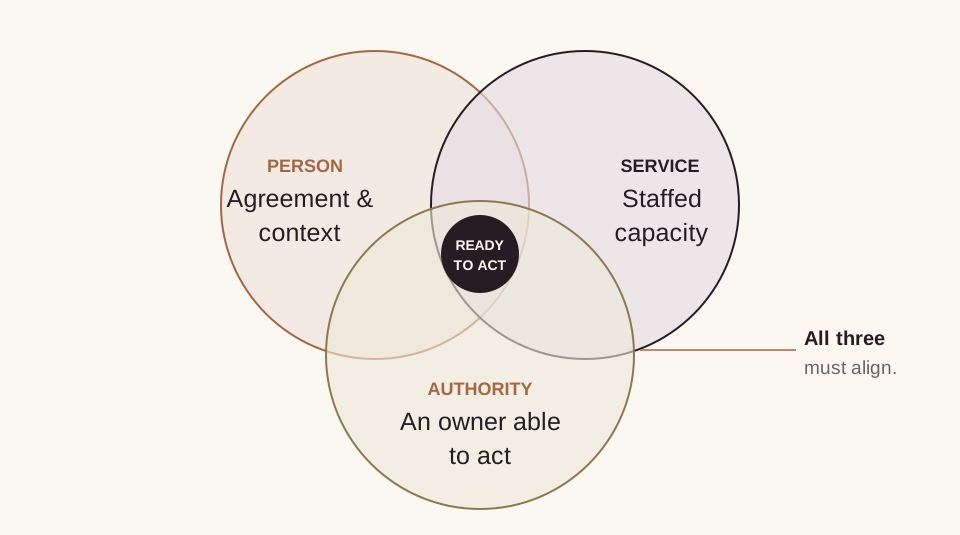 View full-size exhibit ↗
Source & method. My proposed operating model. Circles represent necessary conditions, not measured sets, population proportions or estimated overlap. Readiness to act is not proof that care was completed or effective.
What founders should do
Start with a defined contract, population, workflow or economic problem where a failed handoff prevents the intended result.
Design the implementation around that handoff. Name the receiving team, the action it can take and the capacity required. Then establish how the organization will verify completion and evaluate the change in the patient's care.
Fund the connection together with the capacity to act on it. Expand when the service reliably completes the intended care step and its clinical and economic results justify the next commitment.
Discuss the strategic decision